

This month’s polling breakdown is being written shortly after Andy Burnham’s big speech to Labour’s annual conference. One of the cornerstones of which was his announcement of a National Commission on Electoral Reform and the historic pledge that Labour would “contest the next election with a manifesto commitment to change the electoral system, so that everyone’s vote counts and everyone’s voice is heard”.
This month’s analysis comes too early to pick up any polling movements that may flow from Burnham’s speech. However, it is still an interesting moment to take stock and reflect on a polling picture that looks very different compared with the beginning of 2026.
Here are the polling figures for September.
September UK General Election Polling Averages
The average (mean) vote shares from the most recent September poll by each of the ten polling companies who published a UK general election poll conducted during September, is as follows:
Labour 27.2% (+0.9*)
Reform UK: 23.4% (-0.9)
Conservatives: 19.7% (-0.4)
Greens: 10.3% (-0.2)
Liberal Democrats: 9.9% (-0.1)
Others: 9.5% (+0.7)
* Compared with August’s average - each month a different combination of pollsters will publish polls, so this change is not strictly comparing like with like but gives a general sense of change.
September’s polling average was compiled using data from the following pollsters – BMG; Deltapoll; Find Out Now; Freshwater Strategy; Ipsos; More In Common; Opinium; Survation; Trajectory Partnership; YouGov.
What do these results mean?
In July 2026, the month Andy Burnham became Prime Minister, Labour regained the lead in our monthly polling average for the first time since March 2025. In August, Labour doubled their lead over Reform UK to around two percentage points. Now, in September, they have doubled it again, to around four points. And, at 27.2%, Labour has hit a new high since we started collecting this monthly polling data, in February 2025.
At the same time, Reform UK have fallen to their lowest vote share over this period (23.4%), with the previous low being 24.0%, in March 2025.
This reversal of fortunes is reflected in the graph below, which tracks the progress of the parties across the twenty months that we have been compiling these polling averages.
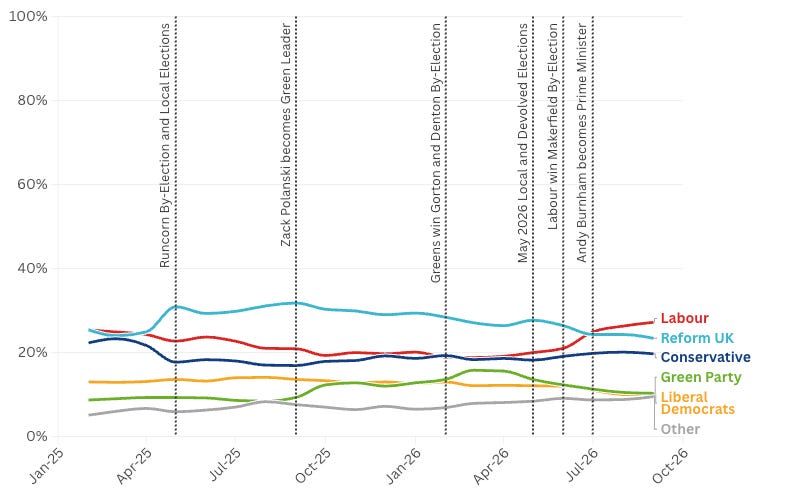
Last month we posed the question of how easy it would be for Burnham to resist the temptation of calling a general election, if the early signs of his potential for coalescing the ‘left’ bloc of voters blossomed into something more substantial, while the ‘right’ bloc continued to be relatively evenly divided, a fatal flaw under First Past The Post (FPTP).
For now, Burnham has squashed election speculation but it is worth keeping an eye on whether the chatter returns, if Labour’s poll lead continues to climb towards the 10-point lead they secured at the 2024 general election.
Something else to note this month is that for the first time since September 2025, there are not five parties who have hit 10% in the polling average, albeit by the slimmest of margins, with the Liberal Democrats dropping to 9.9%.
However, it is worth keeping an eye on the share going to ‘others’. This month that has hit a record high since we started collating this data (9.5%). Some of the ‘others’ share reflects support for the Scottish National Party (SNP) and Plaid Cymru. It does not make sense to record the vote shares of these two parties separately in our polling averages, as their vote shares reflected in UK-wide polls are much less reliable than those in Scotland-only or Wales-only polling.
However, another part of this ‘others’ data reflects support for Restore Britain. Rupert Lowe’s outfit, who occupy a position on the political spectrum that can be broadly classed as to the right of Reform UK. Not all pollsters are currently providing a vote share for Restore, hence us not including them separately in our monthly polling average data. However, across the six companies who published a poll in September and who provided a Restore Britain figure, their average (mean) vote share was 4.0%. This is on the back of the Greater Manchester Mayoral by-election, where the Restore Britain candidate received 8.7% of first preference votes, beating the Conservative candidate.
So, while we have seen some slippage in support for the Greens and Liberal Democrats in recent months, we should not lose sight of the fact that our political environment remains ultra-fragmented.
Which brings us back to the start of this piece and why the Prime Minister’s announcement of a National Commission on Electoral Reform and a Labour manifesto commitment to PR is so vital.
If we keep trying to squeeze a multi-party system into the corset of First Past The Post it will end up bringing our democracy into disrepute.